
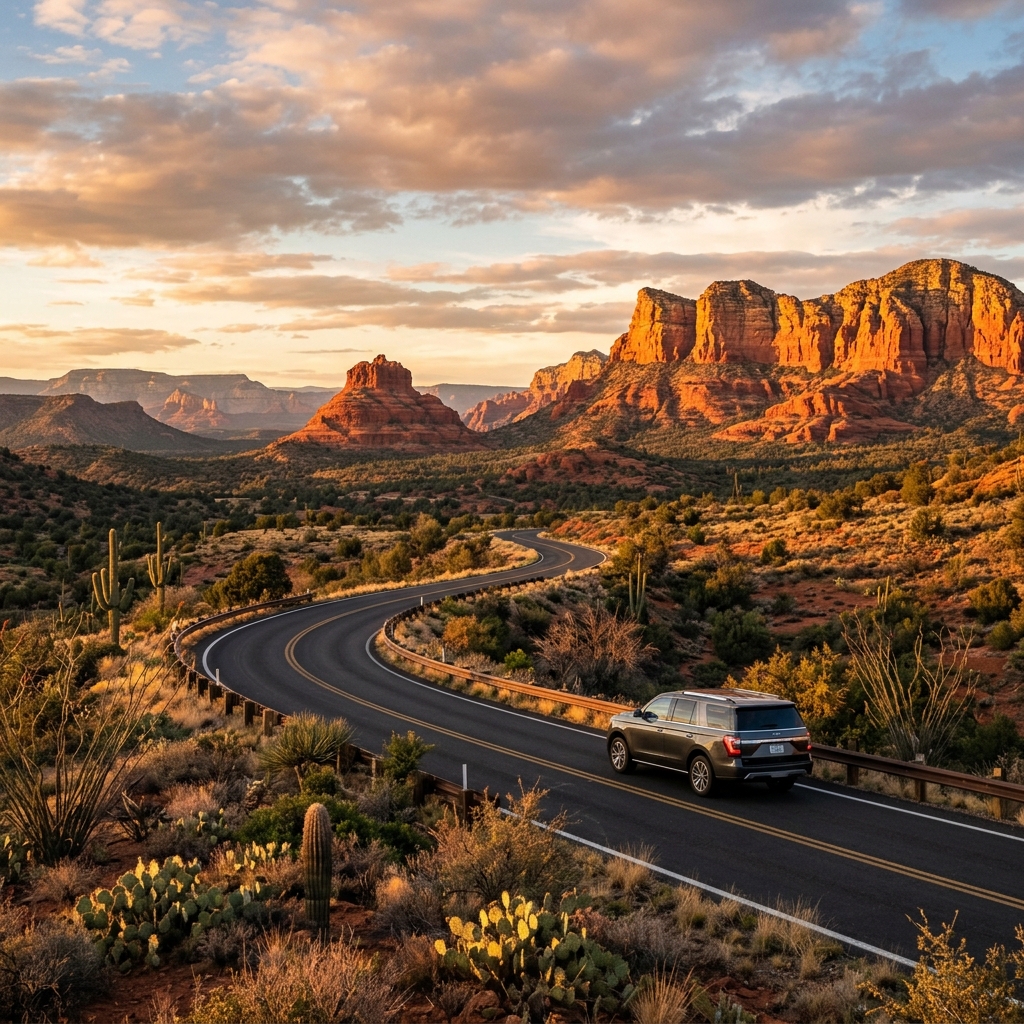
The best Arizona road trip covers Phoenix, Sedona, the Grand Canyon, Page, and Monument Valley in a 7-day loop. This guide includes a day-by-day itinerary, the best stops between destinations, a budget breakdown, packing list, and driving tips so you can plan a smooth, unforgettable trip through Arizona’s red rocks and canyons.
Arizona doesn’t do subtle. One day you’re driving past towering saguaro cacti outside Phoenix, and the next you’re staring down into a canyon so massive it’s hard to process with your own eyes. This is a state built for road trips, where the drive itself is often as memorable as the destination.
This guide walks you through everything you need to plan the ultimate Arizona road trip. You’ll find a detailed 7-day itinerary hitting Sedona, the Grand Canyon, Antelope Canyon, Horseshoe Bend, and Monument Valley, plus the best scenic drives, where to stay, what to pack, and how much to budget.
Whether you have a long weekend or a full week, there’s a version of this trip that fits your schedule.
Why Choose Arizona for a Road Trip?
Arizona packs an unusual amount of variety into one state. You get red rock canyons, alpine forests, painted deserts, and Native American heritage sites, often within a few hours’ drive of each other.
The roads themselves are part of the appeal. Arizona’s highways cut through some of the most photogenic scenery in the country, and pullouts and scenic overlooks are common enough that you’ll never run short of photo stops.
It’s also a road trip-friendly state from a logistics standpoint. Distances between major attractions are manageable, gas stations and rest stops are frequent along main routes, and the weather is predictable for most of the year.
Best Time for an Arizona Road Trip
Timing matters a lot in Arizona, since temperatures swing dramatically by season and elevation.
Spring (March to May): This is peak season for good reason. Temperatures are mild across the state, wildflowers bloom in the desert, and you’ll get comfortable hiking weather in Sedona and the Grand Canyon.
Summer (June to August): Phoenix and lower desert areas can hit 110°F or higher, making this a rough time for desert hiking. However, higher-elevation spots like Flagstaff and the Grand Canyon’s North Rim stay pleasantly cool.
Fall (September to November): Similar to spring, fall offers mild temperatures and fewer crowds than the busy spring season. This is arguably the sweet spot for a full road trip covering both desert and canyon regions.
Winter (December to February): Expect cold mornings and possible snow at higher elevations like Flagstaff and the Grand Canyon’s South Rim, but comfortable daytime temperatures in Phoenix and Sedona. Winter also means the thinnest crowds at major attractions.
How Many Days Do You Need for an Arizona Road Trip?
The right trip length depends on how deep you want to go into each destination.
3 days: Enough time for a Phoenix-to-Sedona-to-Grand Canyon loop. This works well if you’re short on time but want to hit the two biggest highlights.
5 days: Add Page to the mix, giving you time for Antelope Canyon and Horseshoe Bend alongside Sedona and the Grand Canyon.
7 days: The ideal length for the full loop covered in this guide, including Monument Valley and Petrified Forest National Park. Choose this option if you want a well-rounded trip without feeling rushed.
10 days: Extends your time in each location, allowing for extra hikes, side trips to spots like Antelope Canyon X or Lake Powell boat tours, and slower mornings.
Arizona Road Trip Route Map
Picture a loop that starts and ends in Phoenix, arcing north through Sedona, the Grand Canyon, Page, and Monument Valley before curving back south through Petrified Forest National Park.

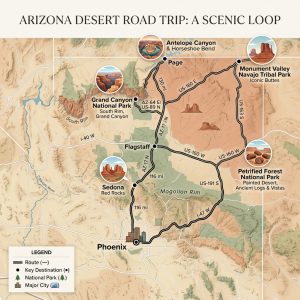
This loop shape means you won’t retrace your steps, which saves driving time and keeps the scenery fresh every day. Most travelers drive this route counterclockwise, as outlined in the itinerary below, though it works equally well in reverse.
Total driving distance for the full loop is roughly 900 miles, with daily driving segments ranging from 90 minutes to just over 4 hours.
Ultimate 7-Day Arizona Road Trip Itinerary
Day 1: Phoenix to Sedona
Start your trip in Phoenix and head north on I-17 toward Sedona, a drive of about two hours.
Best stops between Phoenix and Sedona:
- Montezuma Castle National Monument: This well-preserved cliff dwelling, built by the Sinagua people roughly 700 years ago, is an easy 20-minute detour off the highway.
- Bell Rock: As you approach Sedona, Bell Rock is one of the first red rock formations you’ll see. It has a flat, accessible trail if you want to stretch your legs before checking into your hotel.
Arrive in Sedona by late afternoon, giving you time to settle in before dinner.
Day 2: Sedona Exploration
Dedicate your second day fully to Sedona. Start early with a hike up Cathedral Rock or Devil’s Bridge, both of which offer some of the best views in the region.
In the afternoon, drive Sedona’s Scenic Byway (Highway 89A through Oak Creek Canyon) and stop at Airport Mesa for sunset. The overlook here is one of the most popular spots in town for good reason, especially as the light hits the red rocks.
For a deeper dive into the area’s trails and lookout points, check out our guide to the best things to do in Sedona.
Day 3: Sedona to Grand Canyon
Leave Sedona and head north on Highway 89A, which takes you directly through Oak Creek Canyon.
Best stops between Sedona and the Grand Canyon:
- Oak Creek Canyon: This scenic drive winds through forested canyon walls and is especially striking in fall when the leaves change color.
- Flagstaff: A good lunch stop, Flagstaff also offers a cooler climate and access to the historic Route 66 downtown district.
Continue on to Grand Canyon National Park, arriving in the afternoon with time for your first look at the South Rim before sunset.
Day 4: Grand Canyon to Page
Spend your morning at the Grand Canyon before heading north to Page, about 2.5 hours away.
In Page, prioritize two must-see stops: Antelope Canyon and Horseshoe Bend. Antelope Canyon requires a guided tour to enter, since it’s located on Navajo Nation land, so book ahead. Horseshoe Bend is a short walk from the parking area and doesn’t require a tour, making it easy to fit in during golden hour.
If you have extra time, Lake Powell offers boat tours and kayak rentals for a different perspective on the region’s dramatic rock formations.
For a fuller breakdown of what to see and how to plan your time, see our complete Grand Canyon itinerary.
Day 5: Page to Monument Valley
The drive from Page to Monument Valley takes about two hours through open desert landscape.
Once you arrive, drive the 17-mile Valley Drive loop, which winds past iconic sandstone buttes like the Mittens and Merrick Butte. For a richer experience, consider booking a Navajo-guided tour, which grants access to areas of the valley you can’t reach on your own.
Monument Valley is also one of the best places in Arizona for sunrise and sunset photography, so plan to be out during golden hour if you can.
Day 6: Monument Valley to Petrified Forest National Park
Head south toward Petrified Forest National Park, a drive of roughly three hours.
Inside the park, don’t miss the Painted Desert, a sweeping badlands landscape striped with red, orange, and purple hues. Blue Mesa is another highlight, featuring blue-gray badlands and some of the park’s best-preserved petrified wood.
This park is often overlooked compared to Arizona’s bigger names, but it delivers some genuinely unique scenery.
Day 7: Return to Phoenix
Wrap up your loop with the drive back to Phoenix, roughly 3.5 hours from Petrified Forest National Park.
If you have energy left, consider a short detour to Meteor Crater near Winslow, one of the best-preserved meteorite impact sites in the world.
Best Arizona Road Trip Stops You Should Not Miss
Sedona: Famous for its red rock formations and hiking trails, Sedona is also considered a spiritual hub thanks to its “energy vortex” sites. Plan at least a full day here to hike, shop the local galleries, and catch sunset from one of the many scenic overlooks.
Grand Canyon National Park: One of the most visited national parks in the country, the Grand Canyon’s South Rim offers accessible viewpoints, hiking trails like Bright Angel Trail, and shuttle service between overlooks. Even a short visit here leaves a lasting impression.
Antelope Canyon: This narrow slot canyon near Page is famous for its wave-like sandstone walls and light beams that appear midday. Because it’s located on Navajo land, entry requires a guided tour, so book your Antelope Canyon tour in advance, especially during peak season.
Horseshoe Bend: A short, easy walk leads to this dramatic overlook of the Colorado River curving around a horseshoe-shaped rock formation. Visit near sunset for the best light and smaller crowds.
Monument Valley: Straddling the Arizona-Utah border, this Navajo Tribal Park is home to some of the most photographed rock formations in the American West. The valley has appeared in countless films, and driving through it feels like stepping into a classic Western.
Petrified Forest National Park: Home to fossilized logs dating back over 200 million years, this park also includes the colorful Painted Desert badlands. It’s an easy add-on to the end of your loop before heading back to Phoenix.
Best Scenic Drives in Arizona
- Oak Creek Canyon (Highway 89A): Connects Sedona and Flagstaff through a forested canyon with dramatic switchbacks.
- Monument Valley Loop: A 17-mile dirt road loop through some of the most iconic desert scenery in the country.
- Apache Trail: A rugged, winding route through the Superstition Mountains east of Phoenix, best suited for high-clearance vehicles.
- Desert View Drive: Runs along the Grand Canyon’s South Rim, connecting multiple overlooks over about 25 miles.
Arizona Road Trip Budget Guide
Here’s a rough daily budget breakdown for two travelers on a mid-range 7-day trip:
- Accommodation: $120–200/night
- Food: $60–100/day
- Gas: $40–60/day
- Park entrance fees and tours: $30–80/day (varies depending on Antelope Canyon or Navajo-guided tours)
- Car rental: $50–90/day depending on vehicle type
Estimated total for 7 days (two travelers): roughly $1,800 to $2,800, depending on accommodation choices and how many guided tours you book.
Where to Stay During an Arizona Road Trip
Sedona, Grand Canyon Village, and Page all offer a range of accommodation from budget motels to upscale resorts. Booking ahead is essential during spring and fall, since these are the busiest travel seasons.
For Grand Canyon visits, staying inside the park at South Rim lodges puts you closest to the action, though nearby Tusayan offers more affordable alternatives just outside the entrance. In Monument Valley, staying at a lodge within the tribal park itself offers unbeatable sunrise views over the buttes.
A reliable rental car is key to exploring Arizona comfortably and efficiently. Whether you’re navigating the red rocks of Sedona or the desert roads to Monument Valley, having your own vehicle ensures maximum flexibility. Consider booking your vehicle through trusted platforms like Rentalcars or DiscoverCars for competitive rates and a wide selection of vehicles tailored to your journey. Opt for a high-clearance or 4×4 vehicle if you plan to tackle rugged scenic routes, such as parts of the Apache Trail or Monument Valley.
Arizona Road Trip Packing List
Arizona’s dry climate and big temperature swings mean packing smart matters more than packing light.
- Hiking shoes: Invest in durable, broken-in hiking shoes for trails like Cathedral Rock or Bright Angel Trail. Solid options are available on online or through outdoor retailers.
- Reusable water bottles: Staying hydrated is non-negotiable in the desert. Insulated bottles help keep water cool through long hiking days .
- Camera equipment: Arizona’s landscapes deserve more than a phone camera. Retailers carry everything from wide-angle lenses to lightweight tripods for landscape shots.
- Layers: Mornings and evenings can be cold even when afternoons are warm, especially at higher elevations like Flagstaff and the Grand Canyon.
- Sun protection: Sunscreen, sunglasses, and a wide-brimmed hat are essential given Arizona’s intense sun exposure.
Driving Tips for Arizona
Fill your gas tank whenever it drops below half, since some stretches of highway between towns can run 60 miles or more without a station.
Watch for sudden weather changes at higher elevations, particularly around Flagstaff and the Grand Canyon, where snow can appear even in spring and fall. Download offline maps before heading into remote areas like Monument Valley, since cell service is spotty at best.
If you plan to drive gravel or dirt roads, such as parts of the Apache Trail or Monument Valley’s Valley Drive, a high-clearance or 4×4 vehicle will make the trip far more comfortable.
Common Mistakes to Avoid
Underestimating driving distances: Arizona is bigger than it looks on a map, and mountain roads can slow your pace more than expected.
Skipping reservations for Antelope Canyon: This tour books up weeks in advance during peak season, so don’t wait until you arrive in Page.
Ignoring elevation changes: Flagstaff and the Grand Canyon sit at over 6,000 feet, which can catch travelers off guard with cooler temperatures and mild altitude effects.
Hiking during peak heat: Desert hikes should be tackled early morning, especially from May through September, to avoid dangerous midday temperatures.
Frequently Asked Questions
How much does a 7-day Arizona road trip cost?
A mid-range 7-day Arizona road trip for two travelers costs roughly $1,800 to $2,800, covering accommodation, food, gas, car rental, and park fees.
What is the best time of year for an Arizona road trip?
Spring (March to May) and fall (September to November) offer the most comfortable temperatures for both desert and canyon destinations, along with manageable crowd levels.
Do I need a 4×4 vehicle for an Arizona road trip?
A standard vehicle works fine for the main loop covered in this guide, but a high-clearance or 4×4 vehicle is recommended if you plan to drive rougher routes like the Apache Trail or parts of Monument Valley.
Is Antelope Canyon worth the guided tour requirement?
Yes. Antelope Canyon sits on Navajo Nation land, and guided tours are the only way to access it. The tours also include expert insight into the canyon’s formation and the best times to catch its famous light beams.
Can I do an Arizona road trip in less than a week?
Yes. A 3-day trip can cover Phoenix, Sedona, and the Grand Canyon, while a 5-day trip adds Page for Antelope Canyon and Horseshoe Bend.
Start Planning Your Arizona Adventure
Arizona rewards travelers who are willing to get in the car and cover some ground. Few states pack this much variety into a single road trip loop, from red rock canyons to ancient cliff dwellings to landscapes that feel almost otherworldly.
Use this guide as your starting point, but leave room for spontaneity. Some of the best moments on an Arizona road trip come from an unplanned stop at a scenic overlook or an extra hour spent watching the sun set over the desert.
Book your rental car, pack your hiking shoes, and start mapping out your own version of this route. Arizona is waiting.